
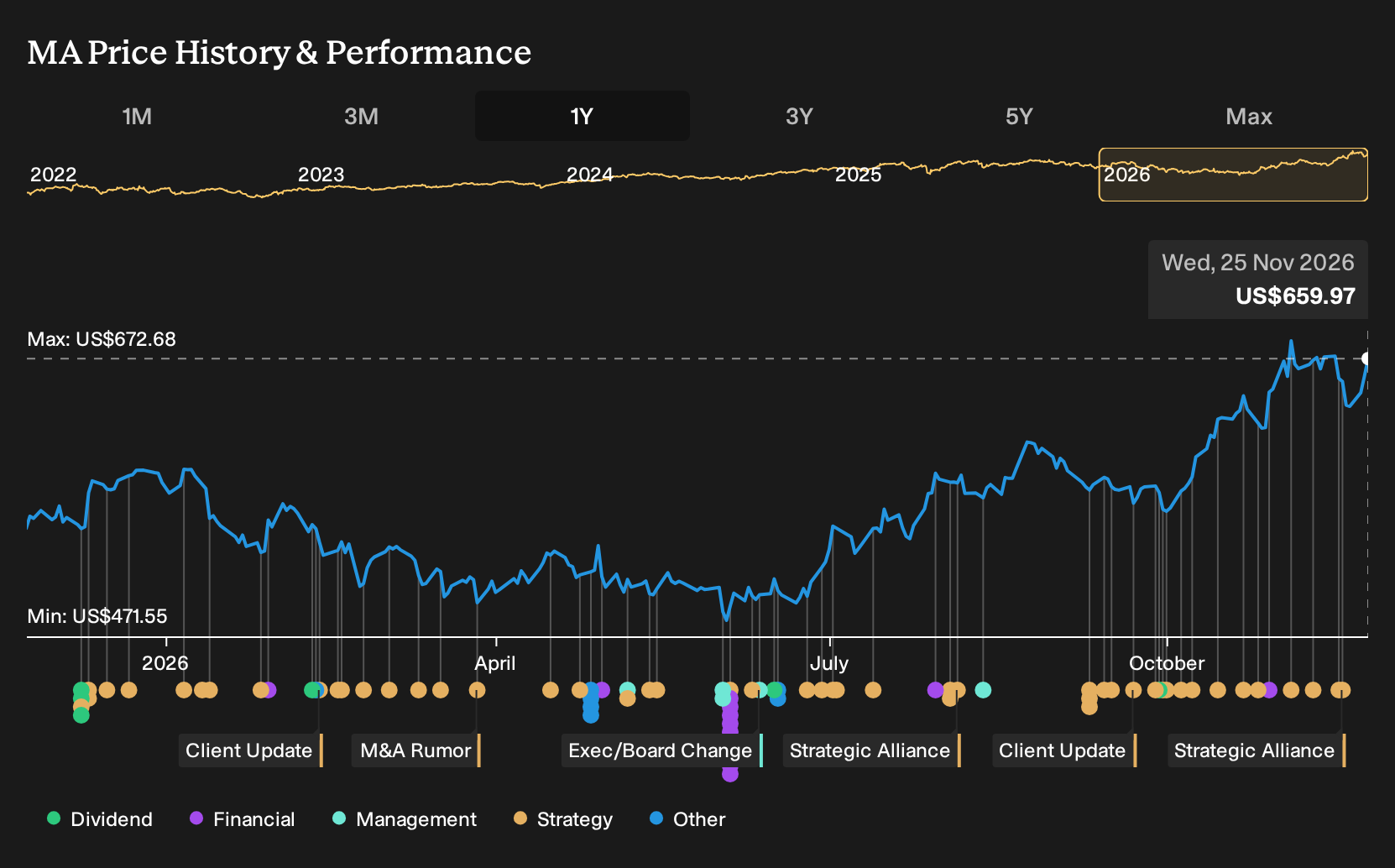
If you only glanced at Mastercard headlines this year, you saw restructurings, a huge US$38b swipe fee settlement process, and Berkshire Hathaway walking away from the card networks. Investors who held Mastercard over the past year are up 21.9%, including dividends. That is a striking outcome next to those risks. If you were weighing an investment on 25 November 2025, what exactly in the public record might have justified taking that ride?
A Narrative on Simply Wall St is one investor's written case for a company, with its growth, margin and multiple assumptions spelled out. Those assumptions imply an estimated Fair Value.
Mastercard has already moved. Pinpoint other ways to investigate the theme among 18 cryptocurrency and blockchain stocks.
The Two Mastercard Stories Investors Had In Front Of Them
The shares cost US$546 at the start of the period, so anyone looking at Mastercard then had to decide which story felt more realistic.
The bullish Narrative saw Fair Value at US$642, 17% above the start price. It leaned on sustained revenue growth from global digital payment trends and partnerships with digital-first players like PayPal, Uber and Mercado Libre.
The more cautious Narrative put Fair Value at US$500, 9% below the start price. It assumed revenue growth of 3.1% a year and a future P/E of 38.3x over a 5 year window, with competition from stablecoins and digital wallets treated as a key risk.
What The Mastercard Evidence Actually Tested
Mastercard’s Q3 2026 figures, with revenue at US$9.8b and net income at US$4.6b against US$8.6b and US$3.9b a year earlier, plus a margin shift from 45.7% to 47.2%, leaned toward the optimistic case that assumed resilient economics and pricing. The US$38b swipe fee settlement process and ongoing UK and US scrutiny pulled the other way. Overall, the period cut both ways.
The hinge assumption was whether strong digital payments growth could coexist with rising regulatory and stablecoin pressure. For a different stock, you would test that by tracking revenue, profit and margin trends alongside any fee caps, settlement terms, or crypto-payment launches that might reshape economics.
What Mastercard's Recent Run Already Prices In
Today Mastercard trades at US$660 after a 21.9% gain over the past year, and the current cautious Narrative sees Fair Value below that price. Esteban, a Simply Wall St Community investor who wrote the Narrative, frames Mastercard as more than a card network.
The argument leans on a payments infrastructure that throws off high margins without heavy reinvestment. A buyer at today’s price has to believe Mastercard can keep growing its value-added services share of revenue faster than the core network without eroding returns.
"Mastercard is a toll-booth on global commerce that has quietly become something more interesting: a toll-booth that also sells the security cameras, the traffic data and the insurance. The company earns a fee on every transaction routed across its network without extending credit, holding inventory, or reinvesting meaningfully to grow. Capital expenditure was $489 million in FY2025 against $17.6 billion of operating cash flow, a capex intensity of 2.8%."
One Narrative disagrees with today's price. → See where this Narrative says Mastercard should trade
Looking One Step Beyond Mastercard
Mastercard highlights global spending habits. You could also watch who handles the spending promise itself.
Card networks move payments. Another business often carries the loan, the customer relationship, and the fraud filters behind each swipe.
It earns money by combining the payment rail with lending, rewards, and compliance systems built around individual users.
Where Mastercard mainly processes transactions, this other player lives deeper in credit risk and regulation.
If trust or rulebook pressure shifts, the ripple can look very different there.
One Narrative has already put a figure on it. → Uncover the company trading 30% below one Narrative's Fair Value
Have feedback on this article? Concerned about the content? Get in touch with us directly. Alternatively, email editorial-team@simplywallst.com