
- Raytheon, an RTX business, recently received a U.S. Navy Other Transactional Authority agreement to move its Nuclear Armed Sea Launched Cruise Missile program from early concept work into a focused development phase that matures the design, integrates subsystems and prepares for prototype demonstrations.
- The project leans on RTX's composable weapons approach and a wider supplier base including Anduril Rocket Motor Systems, Divergent and Williams International. Together these elements point to a modular, scale oriented model that could influence cost, cycle times and capacity planning across RTX's broader missile portfolio.
- We will now look at how this RTX missile development award might reshape the investment narrative around backlog quality and future execution.
Scan how RTX’s latest missile work compares with other defense contractors by jumping into a curated list of 31 resilient stocks with low risk scores that pair resilient balance sheets with contract driven visibility.
RTX Investment Narrative Recap
To be comfortable as an RTX shareholder, you need to believe the firm can keep turning a US$289b backlog and heavy 2026 capex into sustained deliveries, earnings and cash generation, as framed in the analyst consensus Narrative on Simply Wall St. The key near term catalyst remains execution on defense and aerospace programs so that higher volumes actually show up in reported results.
The SLCM N development award sits within that story but does not fundamentally change it on its own. In the short term, the biggest risk still looks operational. RTX is spending US$10b to US$10.5b on engineering and capex while working through supply chain constraints in castings, rocket motors and electronics.
The F 35 engine support award, a US$2.53b Navy contract running through November 2027, ties directly into the same execution question that SLCM N raises for RTX. Together, these programs increase visibility on workload at Pratt & Whitney and Raytheon, and they test whether the recent factory and supply chain investments can handle higher throughput without compressing margins.
For catalysts, investors are now watching how efficiently RTX converts this F 35 work into cash while still funding heavy R&D and capital projects. Smooth execution could support the company’s guidance track record and its current P/E premium. Missteps, whether from cost overruns or supplier issues, would quickly feed into the main risk narrative around free cash flow and returns on that capex.
RTX's current analyst narrative points to US$113.0b in revenue and US$10.9b in earnings by 2029, built on assumed 6.5% yearly revenue growth and an earnings increase of about US$3.2b from the US$7.7b reported today.
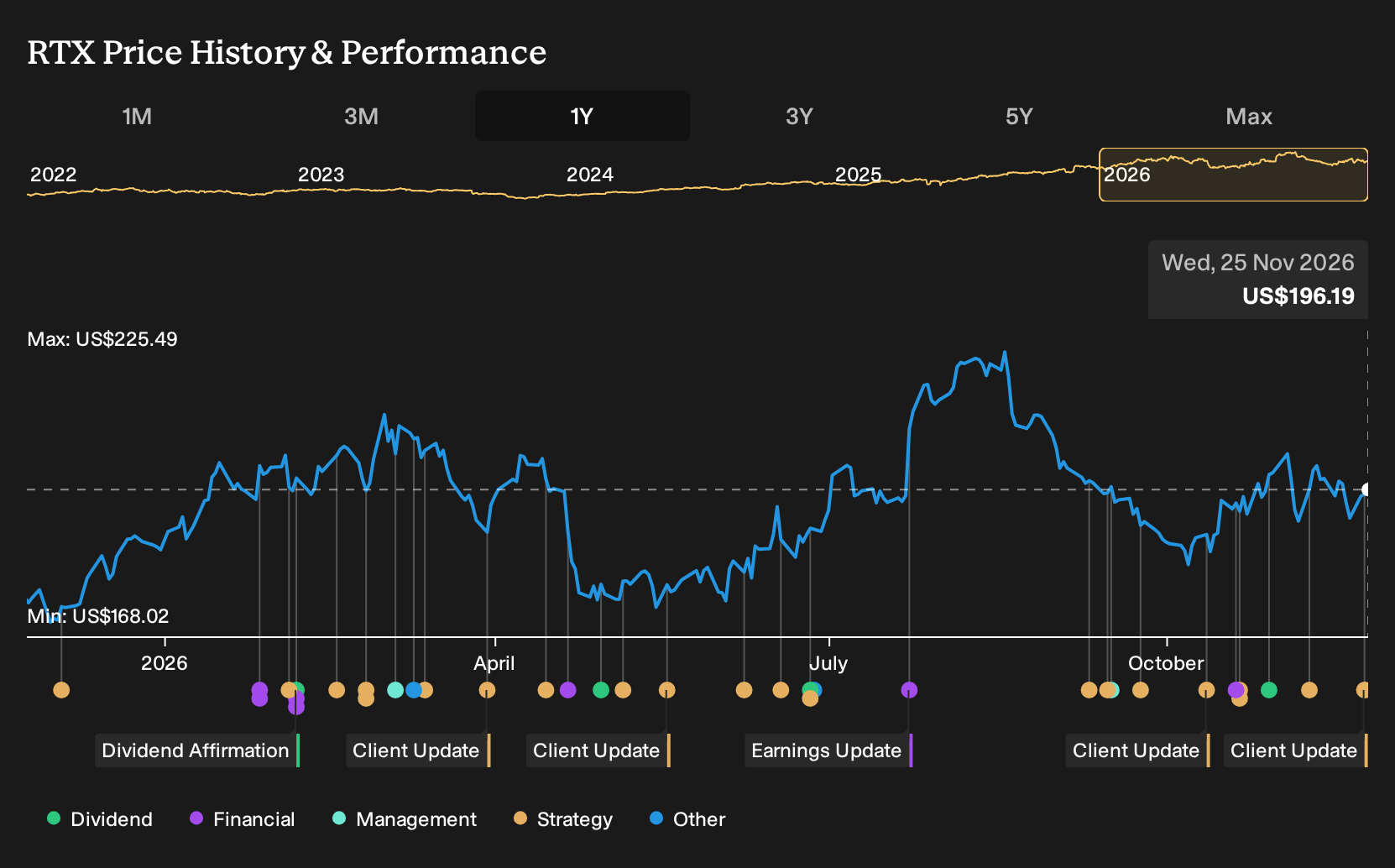
Uncover why RTX's fair value indicates a 17% potential upside to its current price that may not last much longer.
Exploring Other Perspectives
The Simply Wall St Community offers three fair value estimates for RTX, clustering between about US$214 and US$229 a share. Opinions even within this small sample already span a meaningful band. Set those views against the heavy 2026 capex plan and reliance on government programs, and you see why investor opinions can diverge sharply. Explore those alternative viewpoints before deciding how this contract flow fits your own thesis.
Explore 2 other RTX fair value estimates, including one that suggests as much as 17% upside from the current price.
The Verdict Is Yours
Disagree with existing narratives? Extraordinary investment returns rarely come from following the herd, so go with your instincts.
- A great starting point for your RTX research is our analysis highlighting 3 key rewards and 1 important warning sign that could impact your investment decision.
- See our latest analysis for RTX. The report includes a comprehensive fundamental analysis summarized in a single visual, the Snowflake, making it easy to evaluate RTX's overall financial health at a glance.
Looking for more RTX‑style investment ideas?
If the RTX story has sharpened your focus on quality, you can use the Simply Wall St Screener to widen your opportunity set while still keeping a tight handle on risk, income and balance sheet strength.
- For investors who want resilience first and upside second, start with a curated list of 31 resilient stocks with low risk scores that score well on financial stability and business risk.
- If value is your priority, broaden your watchlist with 36 high quality undervalued stocks that combine stronger fundamentals with prices that screen below their estimated worth.
- Income focused readers can zero in on companies that emphasize reliable payouts by reviewing 11 dividend fortresses that pair higher yields with durable cash flows.
Have feedback on this article? Concerned about the content? Get in touch with us directly. Alternatively, email editorial-team@simplywallst.com