
- In recent days, Temu and IndusInd Bank each announced expanded collaborations with Mastercard, spanning Click to Pay, tokenization, fraud reduction, and cross-border money movement through Mastercard Move.
- These partnerships deepen Mastercard's role in e-commerce security and international transfers while tying its value-added services more tightly to merchant and bank workflows across multiple markets.
- We will look at how Mastercard's partnership driven push into tokenized and cross border payments fits into the broader investment narrative.
Mastercard Investment Narrative Recap
To hold Mastercard, you need to believe the toll booth model on global electronic payments continues to attract new volume and that value added services keep gaining relevance. According to Investingwilly, an investor in the Simply Wall St Community, the big story is still high margin transaction fees plus newer products such as tokenization, AI fraud tools and agentic commerce. The latest Temu and IndusInd deals support that direction, but the near term needle mover remains execution on these service lines rather than any single partnership.
The biggest short term swing factor is how management converts strong Q3 value added services momentum into consistent revenue without relying on timing shifts between quarters. The key risk right now is pressure on fees and rules, from state level actions like Illinois interchange limits to ongoing regulatory scrutiny worldwide. Recent ETF buying and sector analyst interest help sentiment but do not change that regulatory overhang.
For this news cycle, the IndusInd Bank agreement around Mastercard Move looks closest to the core thesis. It ties Mastercard deeper into outbound remittances and SME flows from India, an area where banks want faster, more transparent cross border rails. That fits the idea that Mastercard’s growth engine is gradually tilting toward money movement and service layers built on top of the network.
The same pattern shows up in the Temu expansion, the Citizens Treasury Intelligence rollout, the Start Path work with Acoru and Mastercard Accept for small merchants. Each one pulls more activity onto Mastercard infrastructure, but also raises execution demands around security, AI quality, and uptime. If these projects scale smoothly, they can support the catalysts Investingwilly highlighted around durable earnings growth and high returns, while any missteps or regulatory pushback would quickly test that optimism.
On Investingwilly’s numbers, Mastercard reaches a fair value of US$750.00 if revenue compounds at 14.0% a year and the business settles at a future profit margin of 45.9%. Together, these factors support a higher earnings base and justify a richer multiple for a payments infrastructure heavyweight.
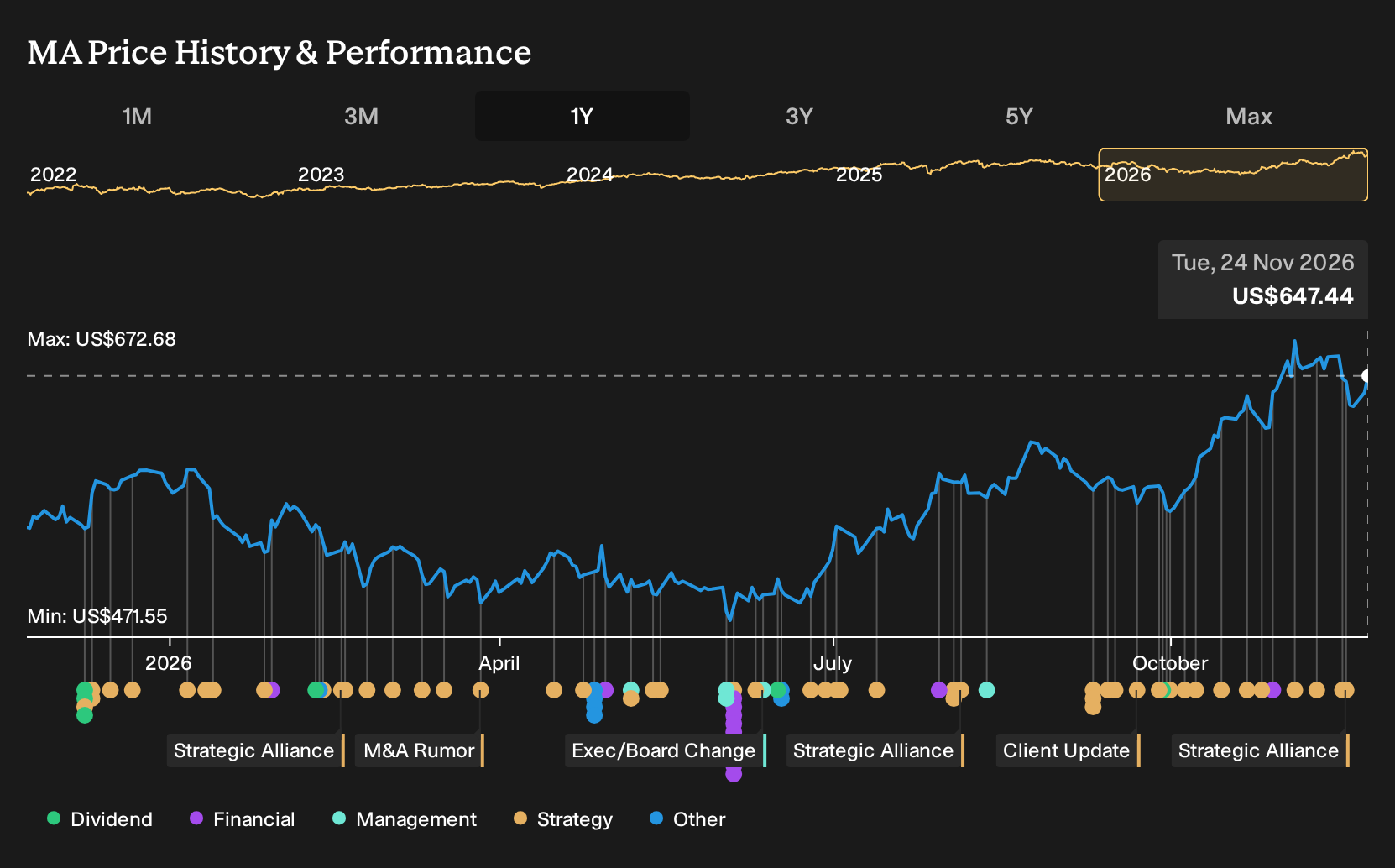
Discover why Mastercard's fair value indicates a 16% potential upside to its current price, a gap that could close as sentiment catches up.
Exploring Other Perspectives
Across 13 fair value estimates from the Simply Wall St Community, Mastercard’s projected worth stretches from about US$620 to US$852, which already hints at sharply different expectations. Those opinions were formed before the Temu and IndusInd Bank collaborations, so you are seeing raw views that do not yet reflect recent tokenization and cross border moves. If you want a fuller picture, compare this spread of retail forecasts with the potential influence of new partnerships, ETF flows and any future regulatory decisions on Mastercard’s earnings power and market perception over time.
Explore 12 other Mastercard fair value estimates, including one that indicates the potential for as much as 32% upside from the current price!
Decide For Yourself
Don't just follow the ticker. Dig into the data and build a conviction that's truly your own.
- A great starting point for your Mastercard research is our analysis highlighting 3 key rewards and 2 important warning signs that could impact your investment decision.
- See our latest analysis for Mastercard. The report includes a comprehensive fundamental analysis summarized in a single visual, the Snowflake, making it easy to evaluate Mastercard's overall financial health at a glance.
Looking for more Mastercard investment ideas?
If the Mastercard story has you thinking about where else digital payments, banking and financial infrastructure might create opportunities, it helps to scan a wider field of businesses with different risk and income profiles.
- For investors who care most about quality at a reasonable price, filter for companies that combine strong fundamentals with attractive valuation using the 37 high quality undervalued stocks.
- If capital preservation and steadier price swings matter more to you than chasing every rally, narrow your watchlist to financially resilient businesses through the 31 resilient stocks with low risk scores.
- For those who want to focus on balance sheet strength and robust cash generation, start with the list of solid balance sheet and fundamentals (23 results) to see which companies clear a higher bar on financial footing.
Have feedback on this article? Concerned about the content? Get in touch with us directly. Alternatively, email editorial-team@simplywallst.com