
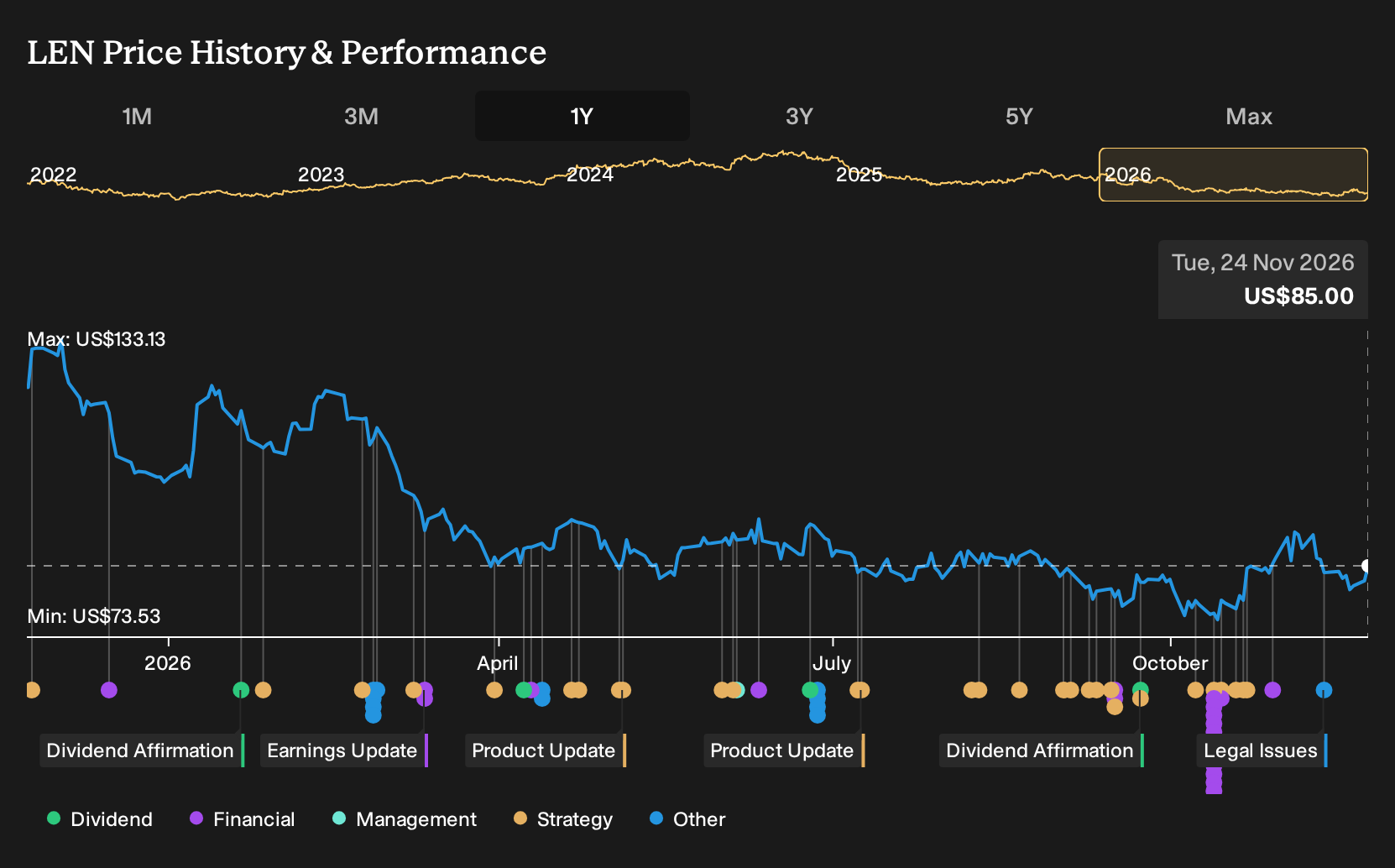
If you had paused in late 2025 instead of backing Lennar through a choppy housing market and rising mortgage costs, your outcome would have looked very different. Holding Lennar over the past year would have meant a 33.7% loss, including dividends. With that result now on the table, which early clues would you have focused on: the bullish growth assumptions, or the bearish margin compression warnings tied to incentives and land banking?
Lennar has already moved. See which of 37 high quality undervalued stocks still trade below our estimates.
The Two Stories Lennar Investors Had To Weigh
The shares cost US$123 at the start of the period, and Lennar holders were effectively choosing between a growth recovery story and a margin squeeze story.
On the upside, the January 2025 thesis from the User pinned a Fair Value of US$169, a price implied by assumptions of 7.0% annual revenue growth, a 10.0% profit margin, and a future P/E of 11.6x over three years.
On the downside, the May 2025 bearish view pointed to a Fair Value of US$95, built on housing demand pressured by high mortgage rates and profit margins declining from 9.1% to 5.5%.
What The Results Did To The Lennar Thesis
The clearest new fact for Lennar holders was the Q3 2026 report. Revenue moved from US$8.81b in Q3 2025 to US$8.05b, while net income dropped from US$585.7m to US$282.0m and net margin fell from 6.6% to 3.5%. That margin outcome leaned toward the cautious case that had flagged pressure from incentives and land banking costs.
The lesson is simple. When a thesis hinges on margins pulling toward 10%, you track the reported net margin line every quarter and compare it directly with the assumed level in the original model.
What Lennar's Lower Price Asks You To Believe
Lennar trades today at US$85, after a 33.7% loss over the past year. The bullish analyst narrative on Simply Wall St views its fair value as sitting above that level, anchored to an asset light, land light shift and the cash flow profile that structure could support.
This view leans on faster construction cycles, heavy use of land bank lots, and the idea that current pricing already incorporates significant affordability and resale competition. For the recent fall to be an opportunity rather than a warning, a buyer would need to believe the asset light model converts into steadier margins despite higher land and option costs.
"The current valuation implies that the market is pricing Lennar as if land banking costs, housing affordability pressures, and resale competition will continue to weigh on margins more heavily than the asset light model and efficiency gains will support them."
One Narrative has put a figure on that disagreement. → See the Narrative with its higher Fair Value, assumptions and all
Go Straight To The Source
This company's disappointment is already part of the story. Your next idea could come from looking where the price and the possibilities still seem far apart. Here are three companies priced below our estimates.
- Company 1 - 31% below our estimate - runs freight forwarding and customs networks handling AI cargo and complex compliance workloads.
- Company 2 - 33% below our estimate - supplies high bandwidth memory and storage addressing capacity bottlenecks in large AI data centers.
- Company 3 - 43% below our estimate - operates gold mines with sizeable reserves, higher production costs and notable geopolitical risks.
Three companies from the same screener. Open the full list of 23 financially solid companies →
Have feedback on this article? Concerned about the content? Get in touch with us directly. Alternatively, email editorial-team@simplywallst.com