
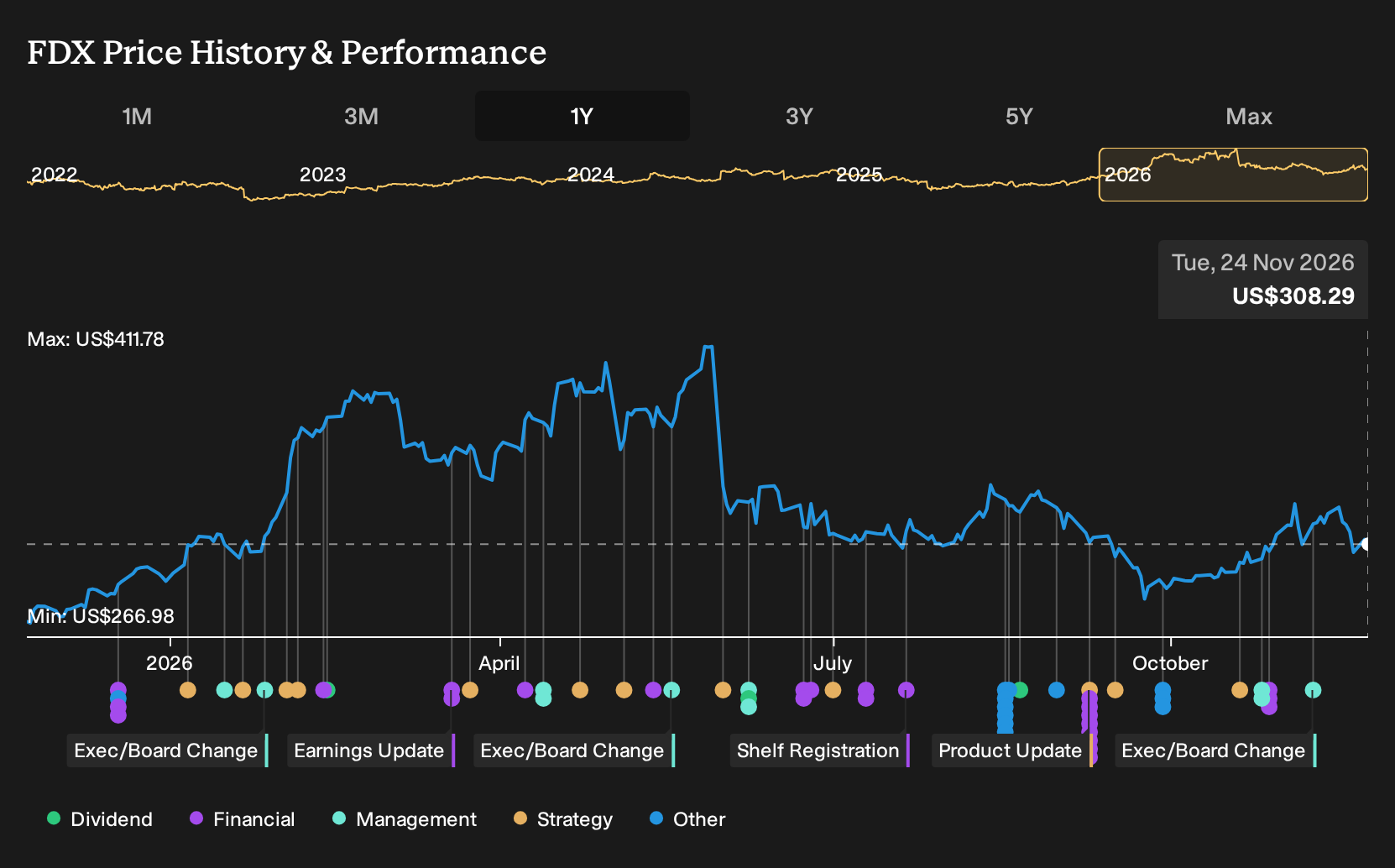
- FedEx reported quarterly results that exceeded earnings and revenue expectations, while continuing to push structural cost programs such as DRIVE and Network 2.0 across its network.
- The business is tightening its focus on higher margin operations and simplification by using cost discipline and portfolio reshaping to reconfigure how it earns profit.
- We will now look at how FedEx's stronger than expected earnings performance might influence the existing cost and automation driven investment narrative.
Scan how FedEx's cost and automation push compares with other potential beneficiaries of efficiency driven earnings stories by reviewing our curated 37 high quality undervalued stocks.
FedEx Investment Narrative Recap
To own FedEx, you need to believe the cost and automation story in the analyst consensus Narrative on Simply Wall St can keep offsetting a fairly low growth backdrop. DRIVE, Network 2.0 and AI tools are all aimed at squeezing more earnings and cash out of a huge fixed network. The key near term swing factor remains execution on those savings while keeping service levels tight.
The biggest operational risk still sits with volume and mix. Any soft patch in higher margin B2B freight, renewed pressure from large contracts like USPS, or pricing strain in international routes could limit margin progress. The latest earnings beat helps confidence in the plan, but it does not fully resolve those volume and yield sensitivities.
The InPost stake is the announcement that connects most directly to FedEx's current catalyst, which is using automation and network design to push unit costs lower. Parcel lockers can cut failed deliveries and consolidate stops, which fits neatly with DRIVE and Network 2.0, especially for B2C e-commerce where drop density matters most for profitability.
That said, this move also adds a new set of execution questions. FedEx and InPost are keeping operations separate. As a result, the benefit relies on how effectively FedEx routes parcels into that locker grid while still prioritizing premium B2B freight. Any integration delays, technology hiccups or weaker than expected adoption of lockers could blunt the efficiency upside investors are watching for.
What The FedEx Forecasts Are Really Asking You To Underwrite
FedEx's narrative projects US$97.7b revenue and US$5.6b earnings by 2029. This is consistent with analysts assuming 1.0% yearly revenue growth and implies an earnings increase of about US$1.2b from US$4.4b today.
Uncover why FedEx's fair value indicates a 14% potential upside to its current price, which could narrow quickly if the cost story gains broader attention.
Exploring Other Perspectives
Some of the lowest FedEx forecasts lean hard into fuel and environmental cost risk, painting a more cautious picture than the recent InPost move might suggest. Those analysts were looking for revenue of US$97.7b and earnings of US$5.3b by 2029. That is materially below consensus, and it shows how far opinions can diverge. Use this earnings beat and the urban greening news as a prompt to compare several narratives before deciding which assumptions you trust most.
Explore 2 other FedEx fair value estimates, including one that suggests it could be worth just $355.10.
Form Your Own Verdict
Disagree with existing narratives? Extraordinary investment returns rarely come from following the herd, so consider relying on your own judgment.
- A great starting point for your FedEx research is our analysis highlighting 1 key reward and 3 important warning signs that could impact your investment decision.
- See our latest analysis for FedEx. The report includes a comprehensive fundamental analysis summarized in a single visual, the Snowflake, making it easier to evaluate FedEx's overall financial health at a glance.
Looking For More Investment Ideas Beyond FedEx?
Once you have a view on FedEx, casting a wider net can help you judge whether the cost and automation story stacks up well against other potential opportunities. The Simply Wall St Screener lets you quickly scan groups of companies that match different risk, income and quality profiles.
- If capital protection is your priority, assess companies that rank well for resilience and balance sheet strength through our 31 resilient stocks with low risk scores.
- For investors who care most about financial robustness, compare FedEx with businesses that pair solid cash generation and cleaner balance sheets using the list of solid balance sheet and fundamentals (23 results).
- If you are hunting for ideas with income potential, sift through companies offering higher yields and sturdier payout profiles via the 11 dividend fortresses.
Have feedback on this article? Concerned about the content? Get in touch with us directly. Alternatively, email editorial-team@simplywallst.com