
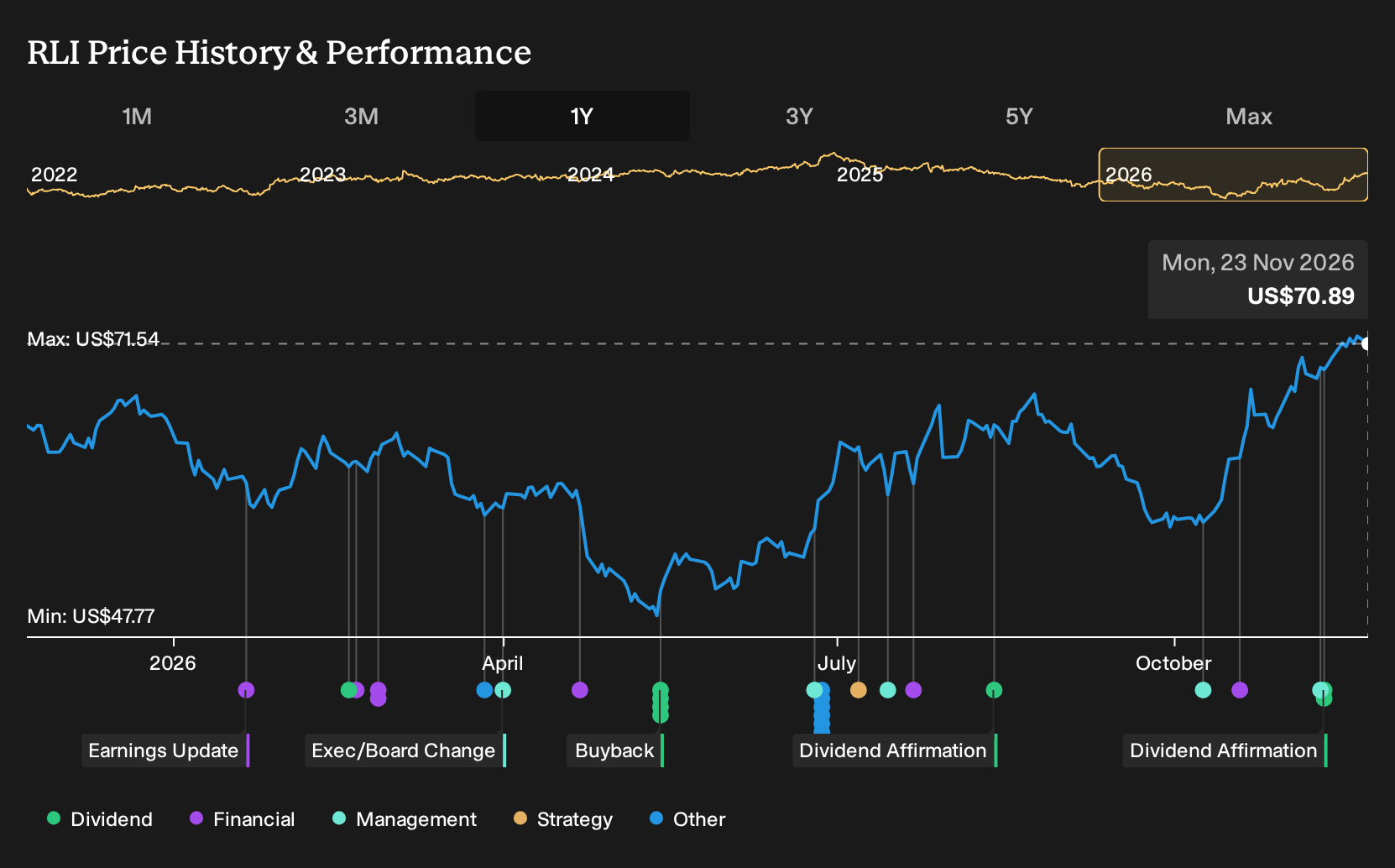
If you only skimmed the headlines about softening property markets, climate risk and regulatory pressure, RLI might have looked like a stock to avoid. Holding RLI over the past year would have returned 21.2%, including dividends. That outcome arrived alongside weaker recent quarterly revenue and margin data, plus fresh analyst caution on future earnings. If you had been weighing those cross currents on 23 November 2025, what would have seemed more important, the risks on record or the discipline on display?
The useful thing about a Narrative is that the reasoning is checkable: the assumptions sit beside the argument, and together they imply an estimated Fair Value you can disagree with.
If the move has made RLI harder to judge, start where the gap is still open and scan 37 high quality undervalued stocks.
The Two Stories RLI Investors Were Weighing
The shares cost US$64.15 at the start of the period, so anyone looking at RLI had to decide which story about the future felt more convincing.
The bullish narrative saw solid execution as the anchor, with a Fair Value of US$74.33 that sat 16% above the start price. It leaned on RLI keeping strong underwriting discipline in softer property markets and using niche growth to support what analysts framed as stable long term earnings.
The bearish view carried a Fair Value of US$59 and focused on climate and tech risks cutting into the same fundamentals. Rising catastrophe exposure and rapid changes in AI and fintech were treated as threats to traditional products, with slower 1.3% assumed annual revenue growth and margins declining from 17.8% to 14.8% in that scenario.
What The Results Changed For The RLI Story
RLI’s Q3 2026 report gave the bullish case something concrete to point to. Net earnings of US$81 million and a combined ratio of 86.2% aligned with the focus on underwriting discipline, even as revenue moved from US$509.3 million in Q3 2025 to US$477.0 million and net margin fell from 24.5% to 17.0%. The evidence cut both ways.
The lesson here is simple. When a thesis leans on “disciplined execution,” it is worth checking it against hard numbers like the combined ratio and net margin, not just growth in written premiums or upbeat commentary.
What RLI's Run Now Asks You To Believe
RLI now trades at US$70.89 after a 21.2% gain over the past year, and the analyst consensus Narrative on Simply Wall St places its Fair Value below that level.
That view hinges on underwriting discipline and expense control. Anyone paying today’s price is effectively assuming that underwriting profit and casualty growth stay on track. The question is how rising catastrophe exposure and a higher expense ratio test that assumption.
"The main thing that has to go right is that RLI sustains its underwriting discipline and service- and technology-supported risk selection while managing higher expenses and softer property and casualty pricing without eroding its historically strong combined ratios. The current valuation and recent bearish analyst ratings imply that RLI's share price already prices in a full outcome on underwriting and capital return, with limited room for disappointment if accident-year loss ratios or growth in key casualty lines fall short."
That disagreement has a full argument behind it. → Uncover the lower Fair Value this Narrative argues for
Looking Beyond RLI's Policy Book
RLI asks you to judge underwriting discipline under pressure. Nearby, another insurer faces a different test.
Here the challenge is scale. Management wants more value from an insurance and health platform using intensive AI investment.
The aim is sharper pricing, faster claims decisions and leaner contact centers, all on one familiar technology stack.
Life and health books are shifting, with older guarantees reduced and new contracts earning more slowly and predictably.
If that AI mix, retail property cover and capital strength align, this business could quietly reshape how everyday risks are priced and serviced.
It is written up in full, assumptions and all. → Explore the Narrative that puts this company 45% above its price
Have feedback on this article? Concerned about the content? Get in touch with us directly. Alternatively, email editorial-team@simplywallst.com