
Charter Communications has had a rough ride over the past few years, and with fresh headlines around investigations and new financing moves, the key question now is whether the current share price lines up with the earnings power of the business.
- The share price has fallen 80.9% over 5 years, which puts the focus squarely on whether the underlying earnings profile still supports today’s valuation.
- Ongoing legal investigations and the fallout from weaker earnings growth and internet customer losses can affect how investors think about the durability and timing of future profits.
- There is a second opinion on Charter Communications worth weighing. See what analysts think Charter Communications's shares could be worth.
The issue now is whether Charter Communications' current market value is properly explained by what the company is earning today and what those profits may reasonably support over time.
If you want a broader starting point for research beyond Charter Communications and these investigations, run the same test on companies filtered through 31 resilient stocks with low risk scores.
Is Charter Communications a Bargain on Earnings?
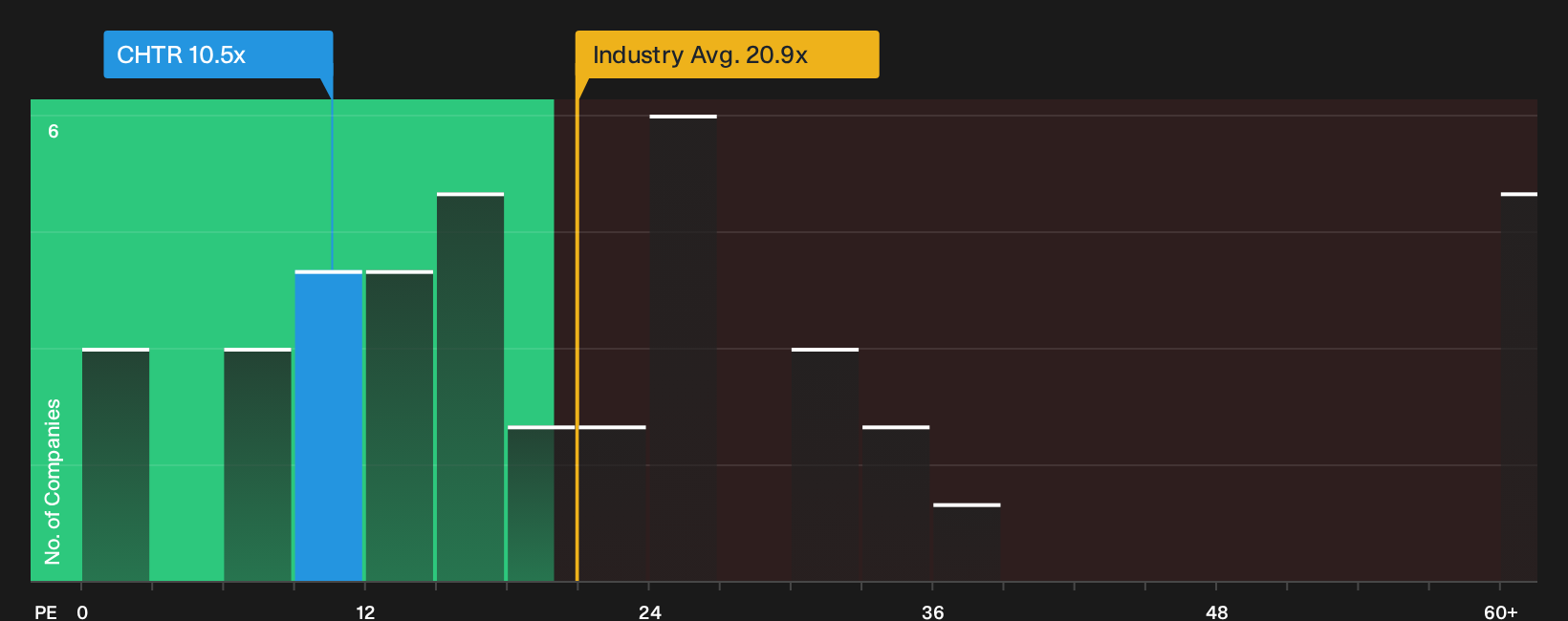
P/E is a useful lens for Charter Communications because investors are focused on how much they are paying for each dollar of current earnings. On this metric, the stock trades on a P/E of 10.5x, which is slightly below the peer group at 10.7x and far below the wider Media sector on 20.9x.
Because the shares screen below a Fair Ratio that reflects Charter Communications' mix of earnings quality, balance sheet risk and sector profile, the market is pricing the stock at a discount on this framework. Despite the ongoing investigations and weaker recent earnings growth, that P/E gap to both peers and the industry suggests expectations being priced in remain relatively restrained compared with many other Media stocks. Explore the numbers behind Charter Communications's P/E valuation.
The Charter Communications Narrative: What Would Justify Today's Price?
Simply Wall St Narratives for Charter Communications pick up where the valuation puzzle leaves off and explain which paths for growth, margins and earnings would need to occur for the stock to be worth materially more or materially less than it trades for today, hosted on the platform's Community page. Instead of a single ratio or model output, these stories describe the future that number relies on so you can watch in real time whether the business is actually tracking that script.
Charter Communications splits opinion because one side sees a compressed valuation tied to free cash flow, while the other leans into broadband and earnings risk.
Bull case: 57% undervalued
According to david_6nroa, an investor in the Simply Wall St Community, the upside case leans heavily on free cash flow and debt dynamics.
"CHTR is nearing the end of a large multi-year network upgrade. Capex, which has been coming in at roughly 11.5B for three years, will decline…"
Discover why this Narrative puts Charter Communications at 57% undervalued.
Bear case: 88% overvalued
The bearish analyst Narrative on Simply Wall St frames the downside around broadband pressure and what that means for future earnings power.
"Although Charter Communications is promoting converged connectivity with mobile and video bundles that reduce churn, the company’s own expectation for around a 1% decline in standalone 2026 EBITDA shows that broadband subscriber and ARPU pressure plus rising controllable costs could prevent the bundle strategy from translating into healthier earnings or margin trends…"
Explore why this Narrative puts Charter Communications at 88% overvalued.
One more Charter Communications angle worth putting on your radar
All of this still leaves one big piece of the puzzle untouched: how professional analysts currently map out the earnings path for Charter Communications over the next few years and how that lines up with today’s pricing. Explore where analysts expect Charter Communications to be in a few years.
Have feedback on this article? Concerned about the content? Get in touch with us directly. Alternatively, email editorial-team@simplywallst.com