
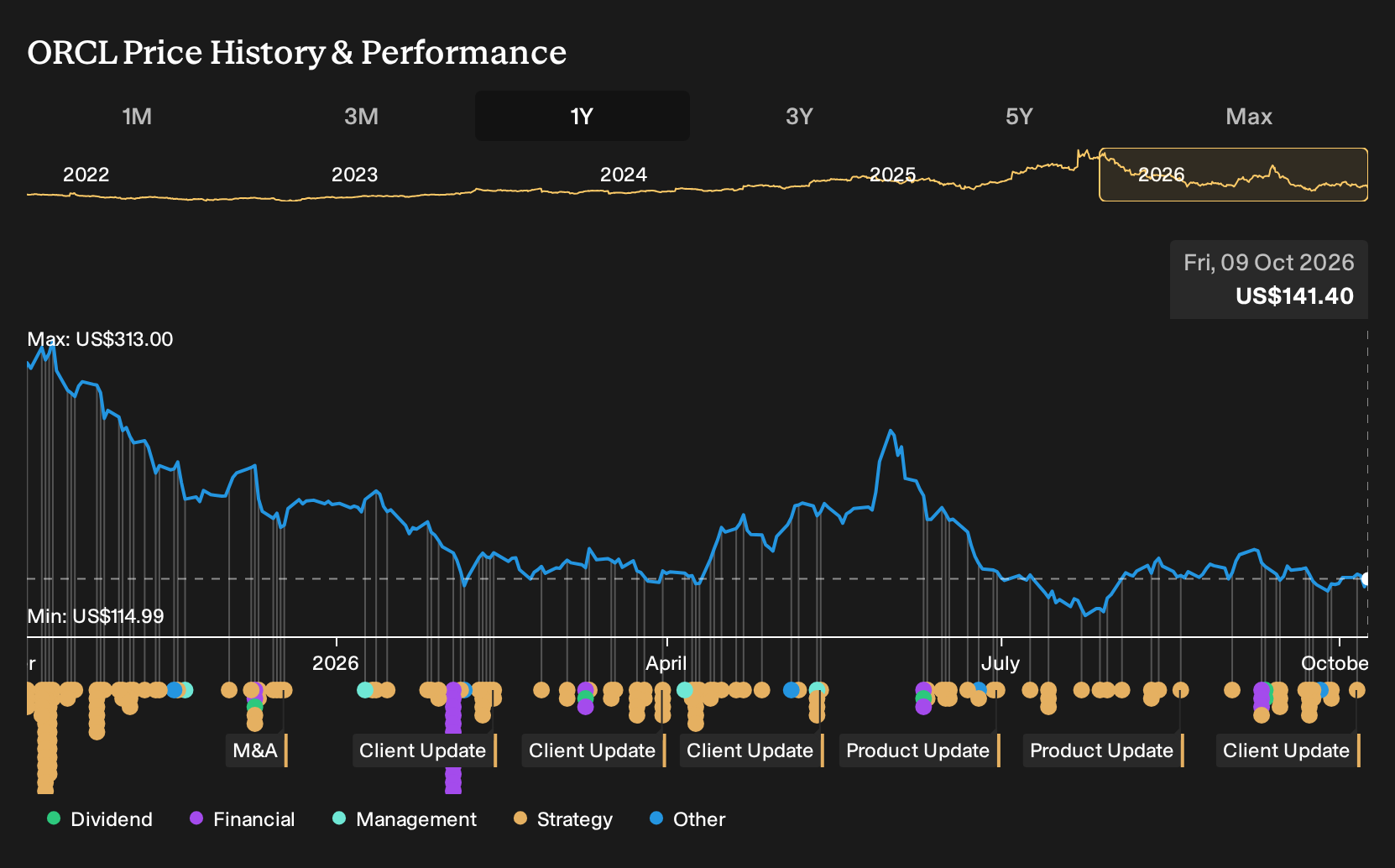
- Oracle has been at the center of several recent announcements, including the launch of Oracle Fusion Claw agentic applications, the planned Oracle Cloud Infrastructure NetApp Storage Service, UiPath Test Cloud listing on Oracle Marketplace, and a blockchain based payments integration with Swift, all aimed at complex enterprise workloads.
- In the same week that these product and client moves were announced, Oracle issued a force majeure notice on its Project Jupiter AI data center in New Mexico, highlighting the operational and funding pressures that can accompany large scale AI infrastructure plans.
- We will examine how Oracle's investment narrative around AI infrastructure and cloud software aligns with its recent agentic application launches.
Scan how Oracle's AI and cloud announcements compare with other potential breakouts by reviewing the hand picked 92 AI infrastructure stocks across the same theme of large scale compute and data pipelines.
Oracle Investment Narrative Recap
To own Oracle, investors need to believe the heavy AI and cloud buildout eventually turns its huge contract backlog into durable, cash generative usage. The core near term swing factor is how quickly new AI data centers and services are brought online and consumed. Recent announcements around agentic applications and partner services point to product depth, but do not remove execution risk.
The biggest immediate risk is still capital intensity and funding. Project Jupiter’s force majeure highlights how physical bottlenecks can delay AI capacity and keep free cash flow under pressure. If usage of already delivered GPU and cloud infrastructure stays strong, that would help offset these timing headaches.
Among the recent updates, Oracle Fusion Claw looks most tied to the current AI story. It links Oracle’s large AI infrastructure spend to concrete, agentic use cases in finance, HR, supply chain, and sales. For an investor, that matters because the thesis leans on turning contracted capacity into high value software outcomes rather than just raw compute.
Execution still has hurdles. Rolling out 25 new Claw powered agentic applications, alongside a broader portfolio of 75, increases complexity in sales, governance, and support just as Oracle is funding roughly US$70b of net AI CapEx and planning about US$40b of new financing. Effective adoption of Claw at existing Fusion clients is a practical catalyst to track against those commitments.
What The Consensus Oracle Forecasts Assume
Oracle's agentic push only really matters for investors if it links back to the numbers analysts are using in their models. Those estimates sketch out a future where the firm leans heavily on its AI infrastructure and cloud contracts, then tries to convert that pipeline into higher earnings, even while margins compress slightly.
Analysts are working off a revenue growth assumption of 39.2% a year over the next three years. Profitability in those models does not expand. Margins are expected to move from 26.1% today to 24.4% by around 2029, which means the story is about scale and utilization more than richer unit economics.
The earnings bridge is steep. Consensus points to earnings today of US$18.7b and forecast earnings of US$47.2b by 2029. That implies an increase of about US$28.5b in absolute profit, or a little more than 2.5x the current level, with a wide spread between bullish and cautious forecasters.
On the top line, the same 2029 framework assumes Oracle reaches about US$193.6b in revenue paired with that US$47.2b earnings figure. For readers, that combination sets a simple test over the next few years. Either AI data center usage, multicloud database demand and agentic software adoption start to line up with this kind of scaling, or the consensus path will need to reset.
Those revenue and profit targets also sit inside a capital structure story. Models incorporate ongoing share issuance, with the analyst set expecting the share count to rise 6.41% annually for the next three years, and they discount future cash flows back using a 9.7% to 9.73% rate. In practice, that means equity holders are underwriting both operational execution on AI and a period of heavier funding activity.
On valuation, the math is straightforward. To support current analyst targets, the stock would be trading at a P/E of 24.2x on the projected 2029 earnings, compared with 22.3x today and below the cited 29.7x multiple for the broader US software peer group. The gap leaves some room for investors who think Oracle's AI and agentic application mix deserves a relative discount, as well as those who think current pricing already bakes in balance sheet strain.
Oracle's narrative projects US$193.6b revenue and US$47.2b earnings by 2029. This rests on 39.2% yearly revenue growth and an earnings increase of about US$28.5b from US$18.7b today.
Uncover why Oracle's fair value indicates a 68% potential upside to its current price. This discount could narrow quickly if sentiment shifts.
Exploring Other Perspectives
Some of the most optimistic analysts tie Oracle’s partner momentum to a different catalyst. They were already penciling in about US$216.9b of revenue and US$52.5b of earnings by 2029, before the UiPath Test Cloud and NetApp on OCI news. You should assume opinions may shift sharply as these new AI and automation deals sink in.
Explore 18 other Oracle fair value estimates, including one that suggests there could be as much as 176% upside from the current price.
Decide For Yourself
Don't just follow the ticker. Dig into the data and build a conviction that's truly your own.
- A great starting point for your Oracle research is our analysis highlighting 4 key rewards and 3 important warning signs that could impact your investment decision.
- See our latest analysis for Oracle. The report includes a comprehensive fundamental analysis summarized in a single visual, the Snowflake, making it easy to evaluate Oracle's overall financial health at a glance.
Looking For More Investment Ideas Beyond Oracle?
Once you have a view on Oracle, it helps to compare that thesis with other opportunities that match your preferred mix of quality, valuation, and risk. The Simply Wall St Screener can surface stocks that fit tight criteria in just a few clicks, giving you a broader watchlist to test against your current holdings.
- If you are hunting for companies that look mispriced relative to their fundamentals, scan through a curated set of 29 high quality undervalued stocks that may warrant a closer look.
- For readers who care most about resilience during rough patches, filter for 31 resilient stocks with low risk scores that still clear a quality bar on balance sheet strength and earnings profile.
- When you want ideas that sit off the beaten path but still show strong underlying metrics, start with a focused group of 20 high quality undiscovered gems and see which stories you want to research next.
This article by Simply Wall St is general in nature. We provide commentary based on historical data and analyst forecasts only using an unbiased methodology and our articles are not intended to be financial advice. It does not constitute a recommendation to buy or sell any stock, and does not take account of your objectives, or your financial situation. We aim to bring you long-term focused analysis driven by fundamental data. Note that our analysis may not factor in the latest price-sensitive company announcements or qualitative material. Simply Wall St has no position in any stocks mentioned.
Have feedback on this article? Concerned about the content? Get in touch with us directly. Alternatively, email editorial-team@simplywallst.com