
Klarna Group plc has expanded its partnership with Wayfair (W), rolling out always-on 0% APR financing for eligible U.S. shoppers and a broader suite of flexible payment options for Canadian customers.
Recent moves suggest investors are warming to Wayfair again, with the share price delivering a 17.82% 90 day share price return and a 33.30% 1 year total shareholder return, even though the year to date share price return is slightly down 1.34%.
Scan beyond Wayfair and this Klarna partnership by checking a curated 20 high quality undiscovered gems that could be setting up for their next consumer demand shift.
Wayfair’s sharp move over the past year raises a simple fork in the road. Is this where most of the rerating has already played out, or does the current valuation still leave clear upside on the table?
Most Popular Narrative: 15% Undervalued
Against a last close of $105.13, the most followed narrative pegs Wayfair’s fair value at $123.34, which points to a material gap that hinges on execution in logistics, merchandising, and physical retail.
Wayfair's proprietary logistics network, CastleGate, is expected to provide a meaningful growth unlock by improving efficiency and customer experience, which can positively impact revenue growth through higher conversion rates and potentially improved net margins.
The opening of physical retail locations, such as the Wayfair store outside Chicago, has shown a halo effect on sales growth in nearby areas, which could lead to expanded market reach and increased revenues as additional stores open.
See why 15 investors see Wayfair as 15% undervalued.
Result: Fair Value of $123.34 (UNDERVALUED)
Still, housing market softness and the recent exit from Germany show how fragile demand and international execution can be if conditions remain difficult for Wayfair.
Find out about the key risks to this Wayfair narrative.
Another View On Wayfair's Valuation
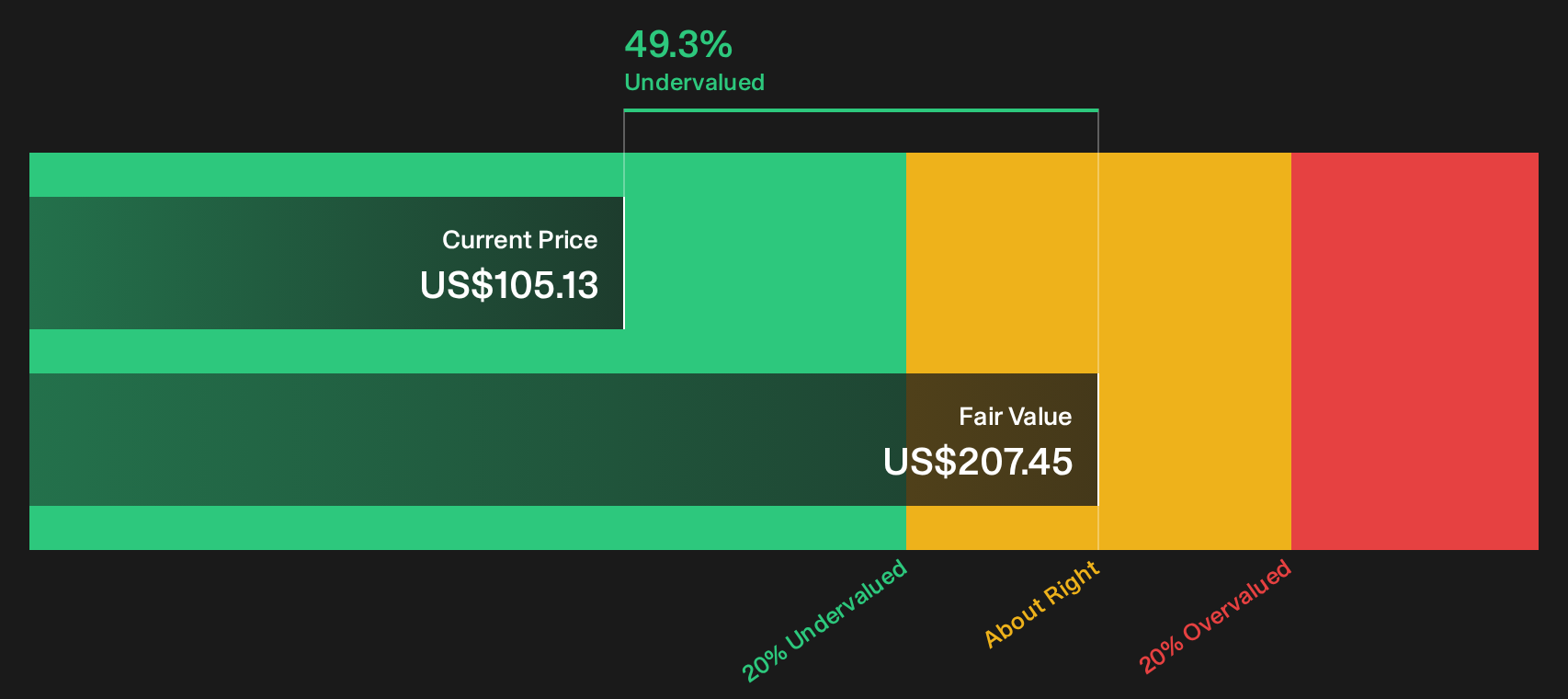
There is a twist. While the most popular narrative frames Wayfair as 15% undervalued at $123.34, the SWS DCF model points to a fair value of $207.45, which is roughly double the current $105.13 share price. That gap raises a simple question: Which set of assumptions do you trust more?
Look into how the SWS DCF model arrives at its fair value.
Next Steps
If this mix of enthusiasm and caution around Wayfair feels familiar, treat it as your cue to act promptly and base your own stance on the data. Start by weighing both sides of the ledger with 2 key rewards and 3 important warning signs.
Looking for more investment ideas beyond Wayfair?
Do not stop at Wayfair. You are already in research mode, so keep that momentum going and line up a few fresh contenders while this insight is still sharp.
- Explore potential opportunities by scanning a curated list of quality companies that appear mispriced through the lens of 27 high quality undervalued stocks.
- Assess resilience by focusing on businesses with relatively stronger financial footing using the list of solid balance sheet and fundamentals (25 results).
- Identify income-oriented candidates by shortlisting companies with consistent payouts using the 8 dividend fortresses.
This article by Simply Wall St is general in nature. We provide commentary based on historical data and analyst forecasts only using an unbiased methodology and our articles are not intended to be financial advice. It does not constitute a recommendation to buy or sell any stock, and does not take account of your objectives, or your financial situation. We aim to bring you long-term focused analysis driven by fundamental data. Note that our analysis may not factor in the latest price-sensitive company announcements or qualitative material. Simply Wall St has no position in any stocks mentioned.
Have feedback on this article? Concerned about the content? Get in touch with us directly. Alternatively, email editorial-team@simplywallst.com