
- In late June 2026, Harley-Davidson, Inc. was reclassified across multiple FTSE Russell indices, moving from the Russell 1000 and Midcap families into the Russell 2000, including value and defensive variants, while also announcing the departure of Chief Legal, Compliance and Corporate Affairs Officer Paul Krause and the appointment of successor Gayle Littleton.
- This reshuffling alters which index-tracking funds hold Harley-Davidson and may influence how investors view the company’s size profile, risk characteristics, and governance stability.
- Next, we’ll examine how Harley-Davidson’s shift into Russell 2000 indices may reshape its investment narrative around scale, liquidity, and investor demand.
Uncover the next big thing with 21 elite penny stocks that balance risk and reward.
Harley-Davidson Investment Narrative Recap
To own Harley-Davidson today, you need to believe the brand can reinvigorate demand across heavyweight and lower-priced bikes while using its HDFS partnership and cost savings to support earnings, despite soft retail trends and macro pressure on big-ticket purchases. The move into Russell 2000 indices and the legal leadership transition do not materially change that near term; the key catalyst remains how effectively Harley redeploys freed-up capital, while the biggest risk is continued weak motorcycle demand.
The most relevant recent announcement here is Harley-Davidson’s capital-light HDFS partnership, which unlocked about US$1.25 billion and underpins its aggressive buybacks and growth investment budget. This balance sheet shift ties directly into how investors may interpret the Russell 2000 reclassification: a company with smaller index stature but meaningful financial firepower. Whether that cash ultimately supports new entry-level products, EV efforts, or brand initiatives will be central to how the post-reclassification story develops.
Yet beneath the index reshuffle, investors should be aware of how prolonged softness in global motorcycle retail sales could interact with Harley-Davidson’s new capital structure and ...
Read the full narrative on Harley-Davidson (it's free!)
Harley-Davidson's narrative projects $3.9 billion revenue and $231.2 million earnings by 2029. This requires revenue to decline by 3.4% per year and implies a modest $0.8 million earnings increase from $230.4 million today.
Uncover how Harley-Davidson's forecasts yield a $25.64 fair value, a 6% upside to its current price.
Exploring Other Perspectives
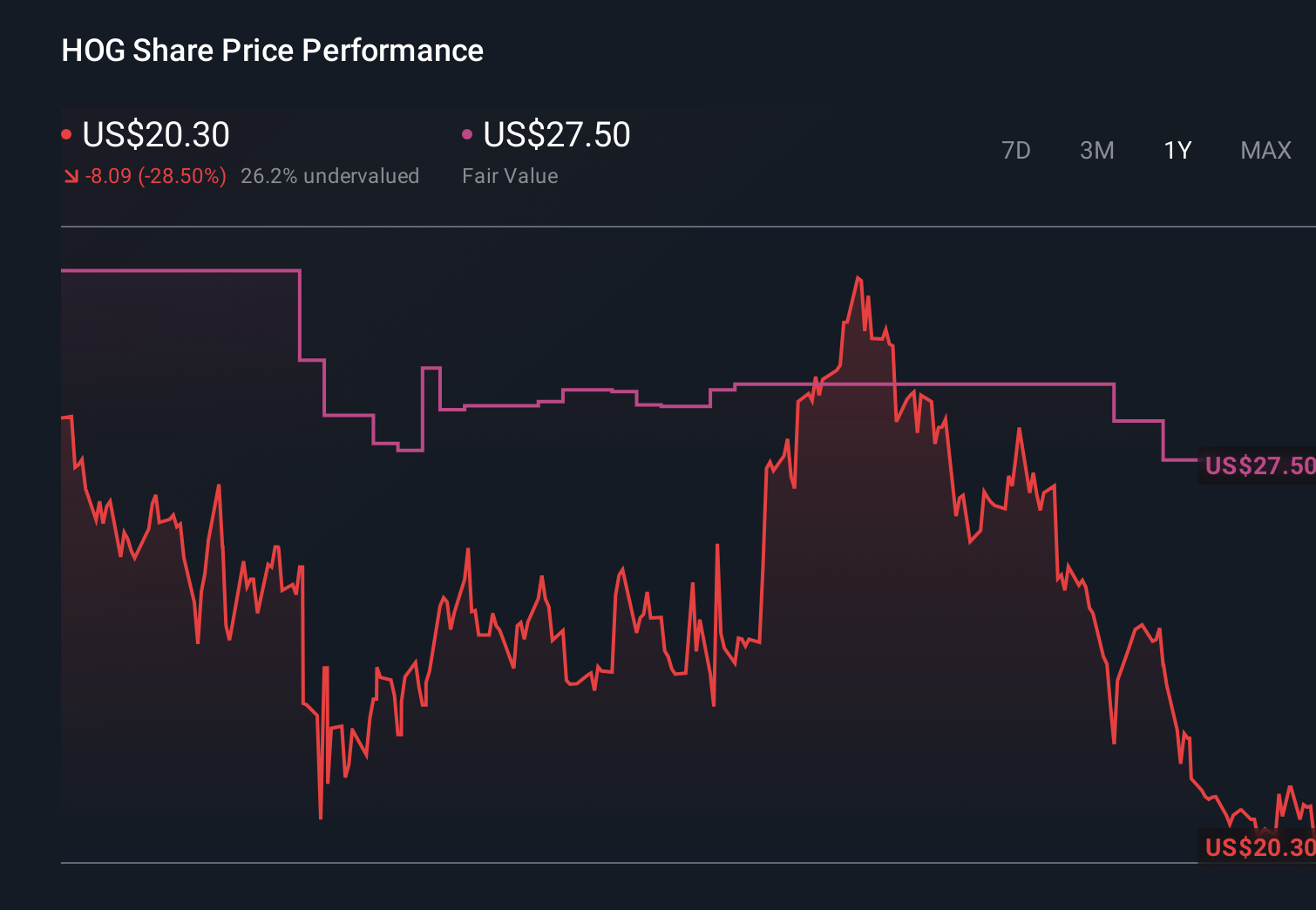
Some of the lowest-estimate analysts were already projecting Harley-Davidson’s revenue to fall about 8.3 percent annually and earnings to drop toward roughly US$193 million, so this index shift and leadership change could prompt them to reassess whether those already cautious expectations still fit the evolving story or need to be revised further.
Explore 4 other fair value estimates on Harley-Davidson - why the stock might be worth less than half the current price!
Decide For Yourself
Don't just follow the ticker - dig into the data and build a conviction that's truly your own.
- A great starting point for your Harley-Davidson research is our analysis highlighting 3 key rewards and 1 important warning sign that could impact your investment decision.
- Our free Harley-Davidson research report provides a comprehensive fundamental analysis summarized in a single visual - the Snowflake - making it easy to evaluate Harley-Davidson's overall financial health at a glance.
No Opportunity In Harley-Davidson?
Markets shift fast. These stocks won't stay hidden for long. Get the list while it matters:
- The best AI stocks today may lie beyond giants like Nvidia and Microsoft. Find the next big opportunity with these 15 smaller AI-focused companies with strong growth potential through early-stage innovation in machine learning, automation, and data intelligence that could fund your retirement.
- Capitalize on the AI infrastructure supercycle with our selection of the 53 best 'picks and shovels' of the AI gold rush converting record-breaking demand into massive cash flow.
- The future of work is here. Discover the 29 top robotics and automation stocks leading the charge in AI-driven automation and industrial transformation.
This article by Simply Wall St is general in nature. We provide commentary based on historical data and analyst forecasts only using an unbiased methodology and our articles are not intended to be financial advice. It does not constitute a recommendation to buy or sell any stock, and does not take account of your objectives, or your financial situation. We aim to bring you long-term focused analysis driven by fundamental data. Note that our analysis may not factor in the latest price-sensitive company announcements or qualitative material. Simply Wall St has no position in any stocks mentioned.
Have feedback on this article? Concerned about the content? Get in touch with us directly. Alternatively, email editorial-team@simplywallst.com