
- Yum! Brands has announced that longtime Chief Operating Officer and Chief People & Culture Officer Tracy Skeans will retire, with her transitioning from her current roles on November 1, 2026, into a Senior Advisor position until March 1, 2028.
- Her planned retirement marks the departure of a key architect of Yum!’s franchising model and culture, prompting a multi‑year leadership transition as the company recruits a new Chief People & Culture Officer and a new Chief Scale Officer.
- With this planned leadership change at the heart of Yum!’s operations and culture, we’ll explore how Skeans’ retirement reshapes the company’s investment narrative.
Uncover the next big thing with 24 elite penny stocks that balance risk and reward.
What Is Yum! Brands' Investment Narrative?
For Yum! Brands, the core investment case still rests on a global, asset‑light franchise platform that throws off solid earnings and supports regular dividend growth, even if those dividends have not always been perfectly consistent. Short term, the two big swing factors are the exclusive talks to sell Pizza Hut and how the new CEO and evolving leadership team execute on simplifying the portfolio while keeping KFC and Taco Bell performing. Tracy Skeans’ planned retirement sits right in the middle of that story: she helped shape the current franchising model, but her two‑year advisory role and the creation of a dedicated Chief Scale Officer point to a managed handover rather than a sudden break. Given the modest recent share price pullback, the leadership news itself does not look like the main driver of market sentiment right now.
However, the mix of high leverage, negative equity and a reshuffled top team is something shareholders should watch closely. Despite retreating, Yum! Brands' shares might still be trading 13% above their fair value. Discover the potential downside here.Exploring Other Perspectives
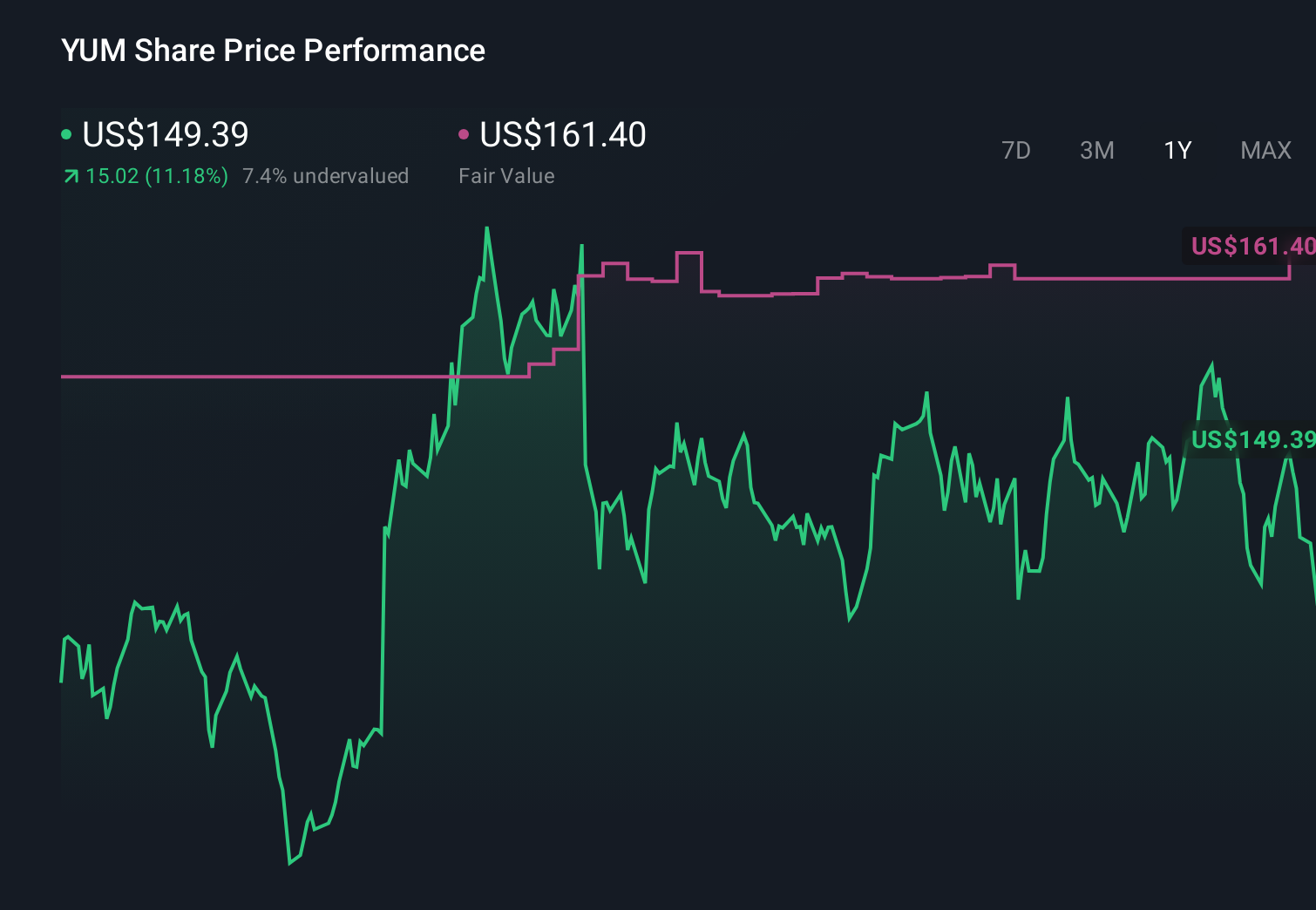
Explore 4 other fair value estimates on Yum! Brands - why the stock might be worth 9% less than the current price!
Decide For Yourself
Disagree with this assessment? Extraordinary investment returns rarely come from following the herd, so go with your instincts.
- A great starting point for your Yum! Brands research is our analysis highlighting 3 key rewards and 3 important warning signs that could impact your investment decision.
- Our free Yum! Brands research report provides a comprehensive fundamental analysis summarized in a single visual - the Snowflake - making it easy to evaluate Yum! Brands' overall financial health at a glance.
Ready For A Different Approach?
Markets shift fast. These stocks won't stay hidden for long. Get the list while it matters:
- The best AI stocks today may lie beyond giants like Nvidia and Microsoft. Find the next big opportunity with these 13 smaller AI-focused companies with strong growth potential through early-stage innovation in machine learning, automation, and data intelligence that could fund your retirement.
- The future of work is here. Discover the 33 top robotics and automation stocks leading the charge in AI-driven automation and industrial transformation.
- Rare earth metals are the new gold rush. Find out which 30 stocks are leading the charge.
This article by Simply Wall St is general in nature. We provide commentary based on historical data and analyst forecasts only using an unbiased methodology and our articles are not intended to be financial advice. It does not constitute a recommendation to buy or sell any stock, and does not take account of your objectives, or your financial situation. We aim to bring you long-term focused analysis driven by fundamental data. Note that our analysis may not factor in the latest price-sensitive company announcements or qualitative material. Simply Wall St has no position in any stocks mentioned.
Have feedback on this article? Concerned about the content? Get in touch with us directly. Alternatively, email editorial-team@simplywallst.com