
- If you are wondering whether Interactive Brokers Group's current price reflects its underlying worth, the recent share performance gives you a useful starting point.
- The stock last closed at US$64.20, with a 1.9% decline over 7 days, a 9.8% decline over 30 days and a 4.5% decline year to date, while still showing a 56.7% return over 1 year, a 216.1% return over 3 years and 258.4% over 5 years.
- Recent coverage has focused on how these price moves fit into broader sentiment around online brokers and trading platforms, including shifts in trading activity and competition among major platforms. This context helps frame whether past returns are aligned with fundamentals or more tied to changing expectations about the sector.
- On Simply Wall St's valuation checks, Interactive Brokers Group currently scores 2 out of 6, which sets the stage for a closer look at different valuation methods and, later in the article, an even more complete way to assess what the stock might be worth.
Interactive Brokers Group scores just 2/6 on our valuation checks. See what other red flags we found in the full valuation breakdown.
Approach 1: Interactive Brokers Group Excess Returns Analysis
The Excess Returns model looks at how much profit a company generates above the return that equity investors typically require. Instead of focusing on cash flows, it starts with book value and earnings and asks whether the business is creating value over and above its cost of equity.
For Interactive Brokers Group, the model uses a Book Value of US$12.04 per share and a Stable EPS of US$1.86 per share, based on the median return on equity from the past 5 years. The Average Return on Equity is 20.52%, while the Cost of Equity is US$0.74 per share. That leaves an Excess Return of US$1.11 per share, which represents the earnings attributed to value creation above the required return. The Stable Book Value used in the model is US$9.05 per share, taken from the median book value over the past 5 years.
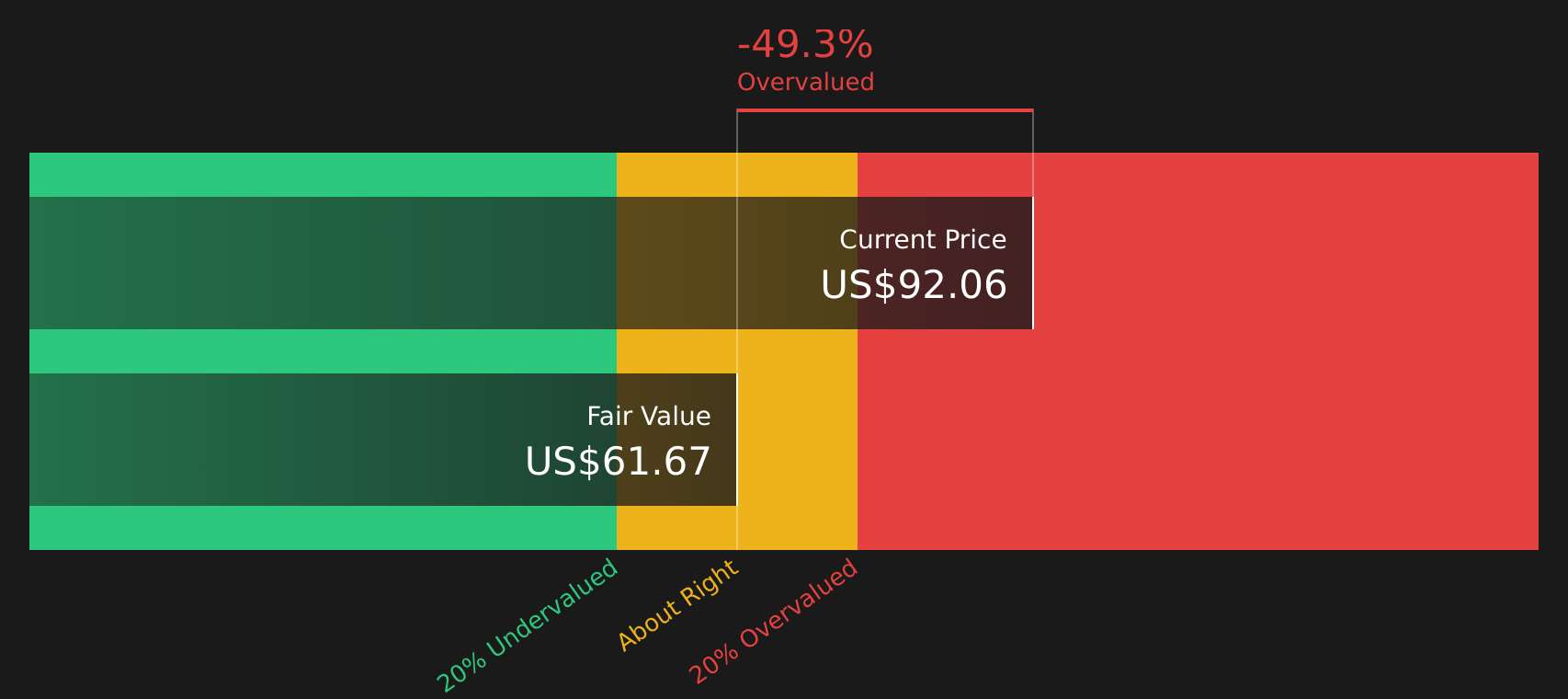
Running these inputs through the Excess Returns framework produces an estimated intrinsic value of US$32.21 per share. Compared with the recent share price of US$64.20, this model suggests the stock is 99.3% overvalued.
Result: OVERVALUED
Our Excess Returns analysis suggests Interactive Brokers Group may be overvalued by 99.3%. Discover 62 high quality undervalued stocks or create your own screener to find better value opportunities.
Approach 2: Interactive Brokers Group Price vs Earnings
For profitable companies, the P/E ratio is a useful shorthand because it links what you pay for the stock to the earnings the business is already generating. It captures how the market weighs those earnings today, without requiring detailed cash flow forecasts.
What counts as a “normal” P/E depends on what investors expect from the company and how risky those earnings appear. Higher expected growth or more resilient earnings can support a higher multiple, while higher risk or more volatile profits usually point to a lower one.
Interactive Brokers Group currently trades on a P/E of 29.07x. That sits below the Capital Markets industry average of 32.20x, but above the peer average of 20.36x. Simply Wall St’s Fair Ratio for Interactive Brokers Group is 20.50x, which reflects a view of what the P/E might be given its earnings growth profile, profitability, industry, market value and specific risk factors.
This Fair Ratio can be more informative than a simple comparison with peers or the broad industry, because it tailors the P/E expectation to the company’s own fundamentals rather than relying on broad group averages. With the current 29.07x P/E above the 20.50x Fair Ratio, the stock screens as overvalued on this metric.
Result: OVERVALUED

P/E ratios tell one story, but what if the real opportunity lies elsewhere? Start investing in legacies, not executives. Discover our 20 top founder-led companies.
Upgrade Your Decision Making: Choose your Interactive Brokers Group Narrative
Earlier it was mentioned that there is an even better way to understand valuation. Narratives on Simply Wall St let you attach a clear story about Interactive Brokers Group to the numbers by linking your view of its future revenue, earnings and margins to a forecast and then to a Fair Value that you can compare with the current price. Multiple Narratives are already live on the Community page, ranging from a more cautious Fair Value of about US$15 per share to more optimistic views around US$81 to US$85. All of these update automatically as new data such as earnings, news or analyst targets come in, so you can see where your own view sits on that spectrum and decide whether the price looks high, low or roughly in line with the story you believe.
For Interactive Brokers Group however we'll make it really easy for you with previews of two leading Interactive Brokers Group Narratives:
🐂 Interactive Brokers Group Bull Case
Fair value: US$80.56
Implied discount to this fair value: 20.3% compared to the recent US$64.20 share price
Revenue growth assumption: 10.76% a year
- Analysts see new products, platform enhancements and international expansion supporting higher trading activity, commissions and a broader client base.
- Record client credit balances of US$107.1b and 178,000 new accounts in a quarter are used as evidence of strong platform engagement and capacity for higher earnings.
- The consensus price target of US$80.56 relies on revenue reaching US$8.4b, earnings of US$1.4b and a 34.7x P/E by 2029, with readers encouraged to test those inputs against their own assumptions.
🐻 Interactive Brokers Group Bear Case
Fair value: US$15.08
Implied premium to this fair value: 325.8% compared to the recent US$64.20 share price
Revenue growth assumption: 6.28% a year
- The narrative highlights very high current profitability, with a pre tax margin of about 79%, and questions how durable that level of efficiency is.
- It points to reliance on trading volumes and net interest income, which could be pressured if market volatility or interest rates move against current conditions.
- Emerging competition from low cost brokers and new trading structures such as tokenized assets is flagged as a risk that could alter Interactive Brokers Group's current advantages.
Do you think there's more to the story for Interactive Brokers Group? Head over to our Community to see what others are saying!

This article by Simply Wall St is general in nature. We provide commentary based on historical data and analyst forecasts only using an unbiased methodology and our articles are not intended to be financial advice. It does not constitute a recommendation to buy or sell any stock, and does not take account of your objectives, or your financial situation. We aim to bring you long-term focused analysis driven by fundamental data. Note that our analysis may not factor in the latest price-sensitive company announcements or qualitative material. Simply Wall St has no position in any stocks mentioned.
Have feedback on this article? Concerned about the content? Get in touch with us directly. Alternatively, email editorial-team@simplywallst.com