
Victoria's Secret stock: what recent performance signals for investors
Victoria's Secret (VSCO) has seen mixed share performance, with the price down about 7% over the past week, 28% over the past month, and 21% over the past 3 months, despite a positive 1 year total return.
Against that backdrop, investors are weighing a value score of 3, an intrinsic discount of about 45%, and annual revenue of roughly US$6.6b alongside net income of about US$160.9m to gauge whether the recent pullback aligns with their risk tolerance.
See our latest analysis for Victoria's Secret.
Victoria's Secret shares have given up some ground recently, with the latest pullback contrasting with a strong 1 year total shareholder return of about 114%. As a result, recent momentum looks weaker than the longer term picture suggests.
If recent volatility has you reassessing your portfolio, this can be a good moment to look at other retail exposed names and broaden your watchlist through 20 top founder-led companies
With Victoria's Secret trading below some estimates of intrinsic value and analyst price targets, the key question now is whether the recent share weakness leaves the stock undervalued, or whether the market is already pricing in future growth potential.
Most Popular Narrative: 44% Overvalued
At a last close of $44.86 versus a narrative fair value of $31.20, the most followed storyline sees Victoria's Secret priced well above its calculated worth, with that view built on detailed earnings and margin forecasts discounted at 10.61%.
The analysts have a consensus price target of $22.7 for Victoria's Secret based on their expectations of its future earnings growth, profit margins and other risk factors. However, there is a degree of disagreement amongst analysts, with the most bullish reporting a price target of $27.0, and the most bearish reporting a price target of just $17.0.
Want the full story on why this fair value sits below the current share price? The narrative leans heavily on modest revenue growth, pressured margins, and a richer future earnings multiple that has to do a lot of heavy lifting.
Result: Fair Value of $31.20 (OVERVALUED)
Have a read of the narrative in full and understand what's behind the forecasts.
However, this story could still be knocked off course if tariff costs hit margins harder than expected or if mall traffic weakens and store sales soften.
Find out about the key risks to this Victoria's Secret narrative.
Another angle on valuation: DCF points the other way
While the popular narrative pegs Victoria's Secret as overvalued versus a $31.20 fair value, the Simply Wall St DCF model presents a very different picture. It shows a fair value estimate of $82.29 versus the current $44.86 share price, which implies the stock is trading at a steep discount.
This kind of gap between earnings based fair value and a cash flow based model raises a practical question for you as an investor: which set of assumptions about margins, growth and risk feels more realistic for the next few years.
Look into how the SWS DCF model arrives at its fair value.
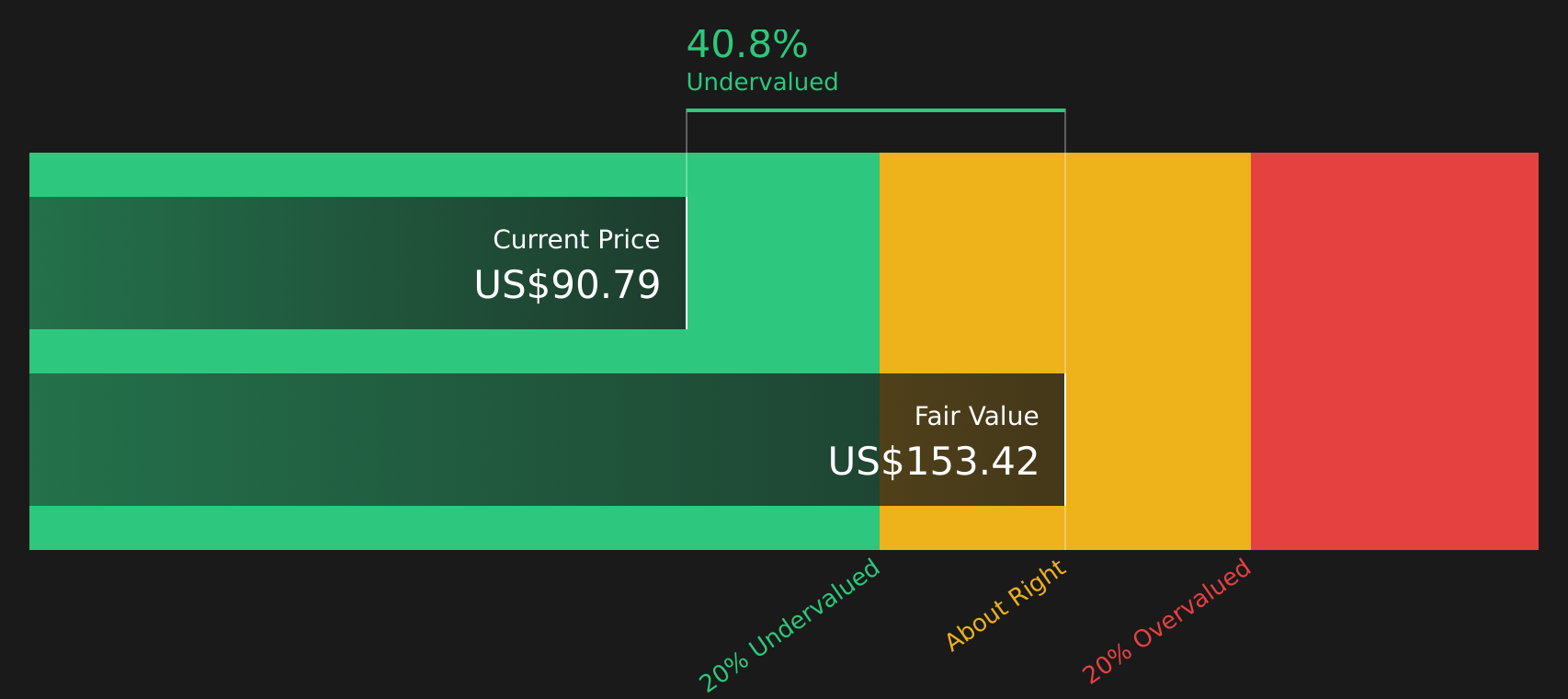
Simply Wall St performs a discounted cash flow (DCF) on every stock in the world every day (check out Victoria's Secret for example). We show the entire calculation in full. You can track the result in your watchlist or portfolio and be alerted when this changes, or use our stock screener to discover 52 high quality undervalued stocks. If you save a screener we even alert you when new companies match - so you never miss a potential opportunity.
Next Steps
With mixed signals on value and sentiment, the real question is what you make of the trade off between risks and rewards. Take a closer look at both sides of the story with 2 key rewards and 2 important warning signs
Looking for more investment ideas?
If this story has sharpened your thinking on Victoria's Secret, do not stop here. Fresh opportunities often sit just outside your current watchlist.
- Target reliable income streams by checking out companies we group as potential income anchors through the 13 dividend fortresses.
- Spot quality at a discount by scanning companies that pair solid fundamentals with attractive pricing using the screener containing 25 high quality undiscovered gems.
- Lower overall portfolio stress by focusing on businesses with steadier profiles using the 68 resilient stocks with low risk scores.
This article by Simply Wall St is general in nature. We provide commentary based on historical data and analyst forecasts only using an unbiased methodology and our articles are not intended to be financial advice. It does not constitute a recommendation to buy or sell any stock, and does not take account of your objectives, or your financial situation. We aim to bring you long-term focused analysis driven by fundamental data. Note that our analysis may not factor in the latest price-sensitive company announcements or qualitative material. Simply Wall St has no position in any stocks mentioned.
Have feedback on this article? Concerned about the content? Get in touch with us directly. Alternatively, email editorial-team@simplywallst.com