
Daqo New Energy Corp. (NYSE:DQ) shares have continued their recent momentum with a 41% gain in the last month alone. Looking back a bit further, it's encouraging to see the stock is up 54% in the last year.
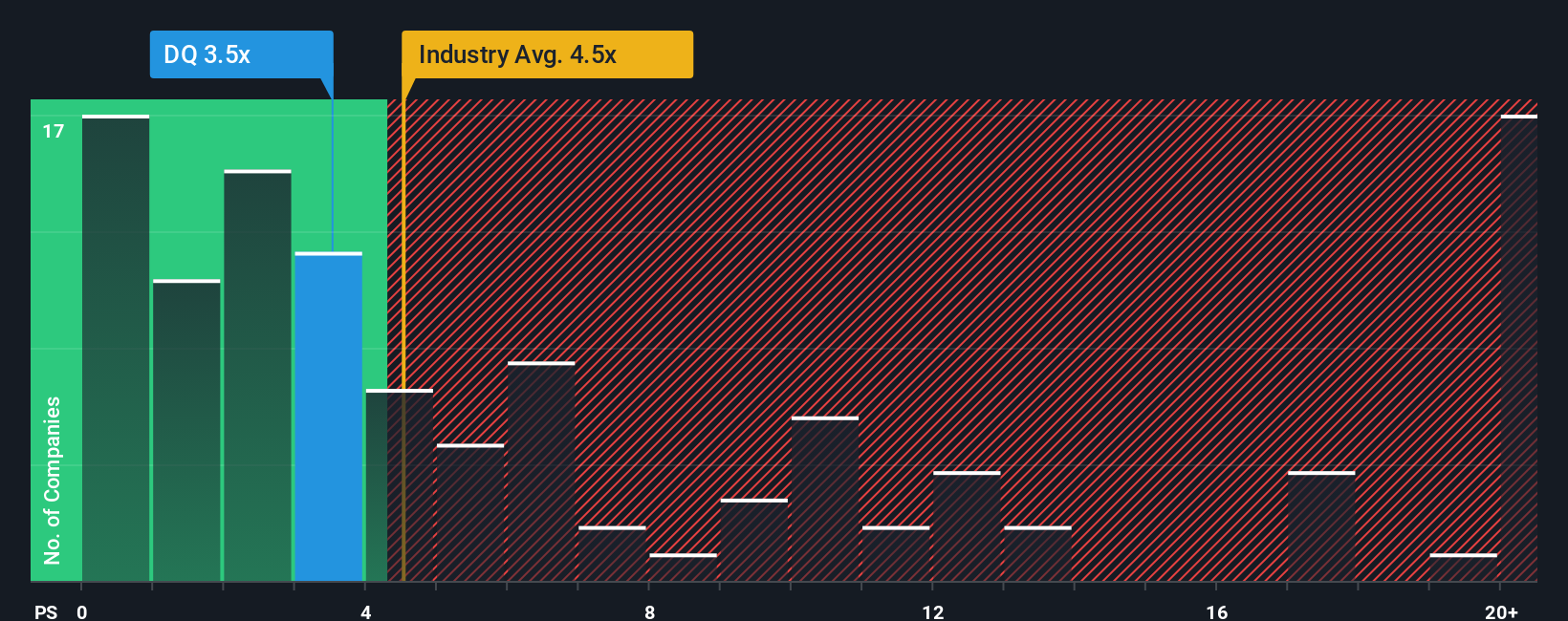
Even after such a large jump in price, Daqo New Energy's price-to-sales (or "P/S") ratio of 3.5x might still make it look like a buy right now compared to the Semiconductor industry in the United States, where around half of the companies have P/S ratios above 4.5x and even P/S above 12x are quite common. However, the P/S might be low for a reason and it requires further investigation to determine if it's justified.
Check out our latest analysis for Daqo New Energy
What Does Daqo New Energy's Recent Performance Look Like?
Daqo New Energy hasn't been tracking well recently as its declining revenue compares poorly to other companies, which have seen some growth in their revenues on average. It seems that many are expecting the poor revenue performance to persist, which has repressed the P/S ratio. If you still like the company, you'd be hoping this isn't the case so that you could potentially pick up some stock while it's out of favour.
Keen to find out how analysts think Daqo New Energy's future stacks up against the industry? In that case, our free report is a great place to start.Is There Any Revenue Growth Forecasted For Daqo New Energy?
In order to justify its P/S ratio, Daqo New Energy would need to produce sluggish growth that's trailing the industry.
Retrospectively, the last year delivered a frustrating 51% decrease to the company's top line. The last three years don't look nice either as the company has shrunk revenue by 85% in aggregate. Accordingly, shareholders would have felt downbeat about the medium-term rates of revenue growth.
Turning to the outlook, the next year should generate growth of 46% as estimated by the ten analysts watching the company. With the industry only predicted to deliver 37%, the company is positioned for a stronger revenue result.
In light of this, it's peculiar that Daqo New Energy's P/S sits below the majority of other companies. Apparently some shareholders are doubtful of the forecasts and have been accepting significantly lower selling prices.
The Key Takeaway
Daqo New Energy's stock price has surged recently, but its but its P/S still remains modest. Generally, our preference is to limit the use of the price-to-sales ratio to establishing what the market thinks about the overall health of a company.
A look at Daqo New Energy's revenues reveals that, despite glowing future growth forecasts, its P/S is much lower than we'd expect. There could be some major risk factors that are placing downward pressure on the P/S ratio. It appears the market could be anticipating revenue instability, because these conditions should normally provide a boost to the share price.
And what about other risks? Every company has them, and we've spotted 1 warning sign for Daqo New Energy you should know about.
It's important to make sure you look for a great company, not just the first idea you come across. So if growing profitability aligns with your idea of a great company, take a peek at this free list of interesting companies with strong recent earnings growth (and a low P/E).
Have feedback on this article? Concerned about the content? Get in touch with us directly. Alternatively, email editorial-team (at) simplywallst.com.
This article by Simply Wall St is general in nature. We provide commentary based on historical data and analyst forecasts only using an unbiased methodology and our articles are not intended to be financial advice. It does not constitute a recommendation to buy or sell any stock, and does not take account of your objectives, or your financial situation. We aim to bring you long-term focused analysis driven by fundamental data. Note that our analysis may not factor in the latest price-sensitive company announcements or qualitative material. Simply Wall St has no position in any stocks mentioned.