Your Investment Strategy
A strategy is simply a set of rules or guidelines that are adopted consistently over time. Having a strategy does not prevent you from having losses.
A strategy may assist in investment success by providing benefits which can include:
- Diversification
- An objective and consistent approach

Diversification
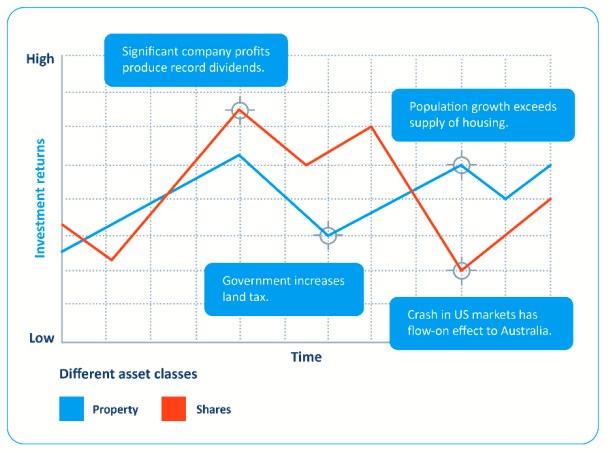
One of the most famous sayings about successful investing is 'don't put all your eggs in one basket'. Markets such as shares and property move in cycles. Many investors fall into the trap of putting all their money into one asset class - usually at its peak, and then watch as another asset class takes off without them ('asset class' refers to a main investment area, like shares, or property).
It is better to diversify, spreading your risk, and enjoy the upturns in markets because you are already in them, rather than trying to 'time the market'. Diversification serves to protect overall investment returns. That is, while one element of the portfolio is performing poorly, some other investment may be doing well.
Importantly, proper diversification does not simply serve to have the gain in one investment compensate for the loss in the other. Effective diversification should also see the combined total of all investments advance in value as well. Being aware that there is no investment that will do well at all times can help reinforce the need to adopt a diversified approach to investing.
An objective and consistent approach
Investors form views about where they think the market is heading or about the value of individual shares. Some allow their emotions to override their rational analysis. Having a detailed strategy can help to counteract the chances of investing with the heart not the head.
Having a documented strategy will also assist you in repeating your successes and avoiding repetition of your failures.
Developing a strategy that incorporates adequate research, and monitoring elements will go a long way to providing a sound investment portfolio.